Full day
The full day from the capital
Cholula, Tonantzintla, Puebla
- Length11 hours
- At Cholula90 minutes
- Pricefrom $55
Guides
Language
Currency
Find a datefrom $55 · cancel without payingYour group, priced
Review 4 options
Compare the day tours that visit Cholula for your group size.
≈
View≈
View≈
View≈
ViewGetYourGuide's starting prices, converted at the ECB reference rate; exact pricing appears when you book.
How to visit the Cholula pyramid, from its stages and tunnels to the hours and fees INAH lists, plus the indigenous baroque church that fills the rest of the day.
Editorial team, pueblatour.click · Updated November 23, 2026 · 9 mins to read
Summary view
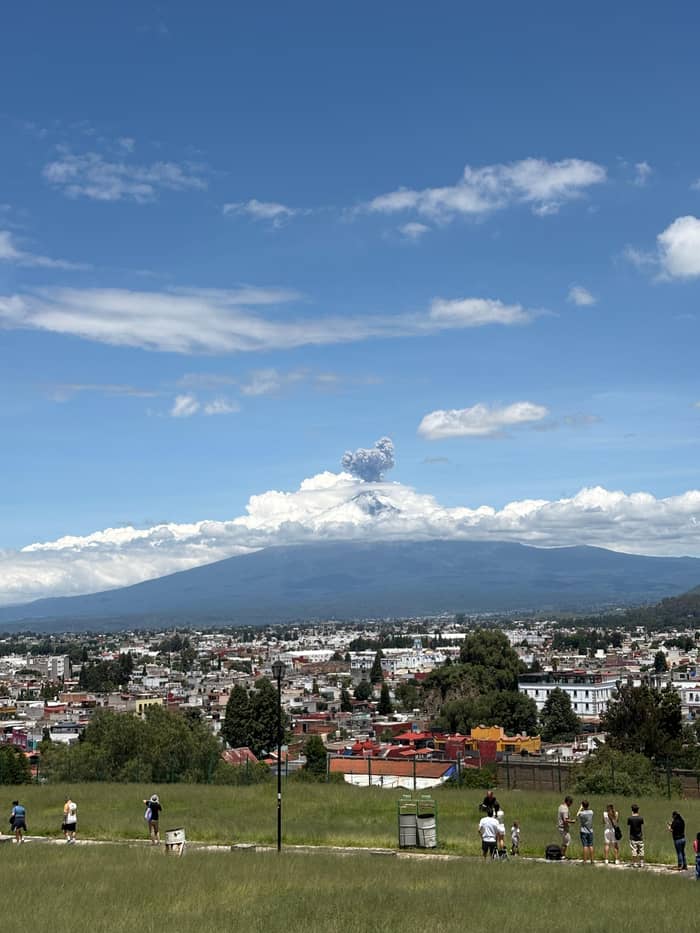
Seen from a distance, the Great Pyramid of Cholula does not look like a pyramid at all, and it helps to know that before you plan your visit. INAH says the ruin turned the complex into a mound blanketed by trees, earth and weeds,6 and the site was also known as Tlachihualtepetl, the hill made by hand.7 A church crowns the summit, and INAH says the Spanish built it in honor of Our Lady of Remedies at the highest point of the pyramid.8 The result is a landmark that confuses first-time visitors and rewards the ones who walk around it.
Under the grass lies the pyramid with the largest surface in Mesoamerica. INAH gives 450 m per side for the Great Pyramid of Cholula, dedicated to Tlaloc.1 The builders started from a natural rise and stacked structures over it, stage after stage,8 and the chronology INAH gives for the site runs from 650 BC to AD 1521, mainly Classic, AD 200 to 800.9 A look from the road is underwhelming; the walk along its base is not, because only then does the scale become a physical fact.
The place name is as layered as the pyramid. The word Cholula comes from the pre-Hispanic Chollolan, which means place of flight.10 The ancient city once rivaled Teotihuacan, El Tajin, Monte Alban and Xochicalco,11 and it was a market town as well as a sanctuary: its market, called tianquiztli, ranked among the best known of Mesoamerica.12 That blend of pilgrimage and trade is the thread running through everything else on this page, from the mural scenes to the golden church in the village nearby.
At a glance
| Topic | Detail | Source |
|---|---|---|
| Size | 450 m per side1 | INAH zone page |
| Chronology | 650 BC to AD 15219 | INAH zone page |
| Hours | Open Wednesday to Sunday, 9:00 until 17:002 | INAH zone page |
| Fee | 210 MXN, or 105 MXN for nationals and residents3 | INAH zone page |
| Tunnel route | About 280 m, closed until further notice4 | INAH zone page |
| Museum | 3 permanent rooms21 | INAH zone page |
| Distance to Puebla | 7 km22 | INAH zone page |
| Church on top | Our Lady of Remedies8 | INAH zone page |
All figures are as INAH lists them; fees and the tunnel status can change, so check the official page before you travel.
INAH describes the site of the first temple as chosen above a spring, because spring water carried magical-religious meaning.13 Over time the base grew larger. Unlike other Mesoamerican buildings, the pyramid used large blocks of compacted adobe stuck together with mud to form an enormous core.14 An early stage carried panels with a mural of insects whose heads resemble human skulls, called los chapulines, the crickets.15 Part of the story is the way each later stage swallowed the one before it, so the story is told in layers rather than as one building.
The accumulated building made a hill of monuments. INAH repeats a saying that the hill carries seven pyramids stacked on its summit.16 The site's murals, Los Bebedores and Los Chapulines, are recognized among the most important in Mesoamerica.17 The mural of the drinkers shows a ceremony in which many people hold vessels for a whitish alcoholic drink, most likely pulque, and INAH counts it among the richest examples of pre-Hispanic mural painting.18 It is a rare glimpse of a social scene on a monument usually remembered for its size.
Recent works have added detail. On the east side of the pyramid, works on the Escalinata del Pocito found brazier fragments piled up, showing sustained use of fire on the pyramid, with each broken brazier covered by a new one.19 The same works found the preform of a cylindrical Tlaloc sculpture in white stone, 30 cm tall.20 The finds are a reminder that the pyramid is still an active excavation and conservation site, not a finished monument, and that what you see changes with each season of work.
Time on the clock
Minutes from the site tour's listing; Puebla (2.33 hours) and the coach back (2.5 hours) are given in hours and left off the bars.
INAH tells the end in plain terms. Wars and calamities struck the holy city, and an eruption of the Popocatepetl volcano sped up its crisis.23 By the time Cortes arrived, the site now open to the public had already been abandoned and destroyed for eight centuries.24 What remained was a hill, and that is how a pyramid of this size hid in plain sight: trees took root on its slopes, and the stages that INAH describes lay buried under soil for the centuries that followed.
Hernan Cortes and his army reached the city, then called Cholollan, in November 1519.25 INAH notes that Cortes carried out one of the cruelest slaughters in recorded history at the new ceremonial center, to intimidate the Tenochca.26 By then the pyramid had been a hill for centuries, and Fray Toribio de Benavente, known as Motolinia, recognized it as the ruins of an ancient teocalli.27 It is a sobering history to carry up to the viewpoint, and a good guide will not skip it.
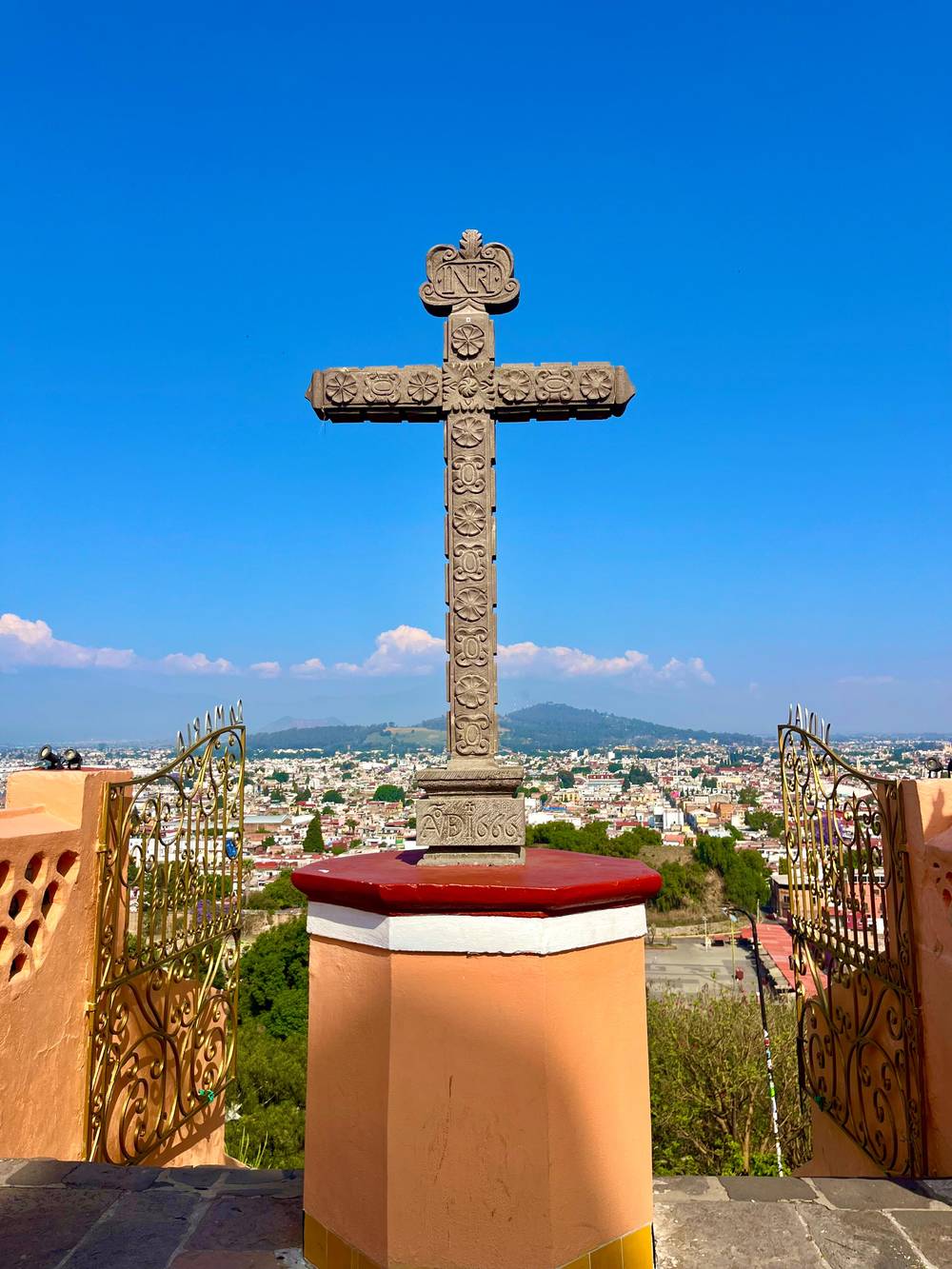
On top, the Spanish built a church in honor of Our Lady of Remedies at the highest point.8 Reaching it is part of many visits, though a small-group listing notes that the pyramid has no lift to the top, so allow time for the stairs and for the thinner air of a high valley. From the summit area the plain opens out, and when the sky is clear the volcanoes that shaped the story show on the horizon.
Pick your day
Match what you want from Cholula to the day that gives it.
If I want the whole pyramid site
Go from Wednesday to Sunday
INAH lists those days, from 9:00 to 17:00.2
If I only have a Tuesday
Expect a panoramic visit
A listing notes that on Tuesday the visit to Cholula is panoramic.
If I am coming from Mexico City
The 11-hour day tour
It stops at Cholula for 90 minutes and at Tonantzintla for 40 minutes, from $55.
If I am already in Puebla
The 4-hour tour from Puebla
It starts in Puebla and visits Cholula and Tonantzintla, from $84.
If I prefer a small group
The 10-hour small group day
It is limited to 15 participants, from $192.
If I want to walk the tunnels
Check the status first
INAH lists the tunnel route as closed until further notice.4
Three ways in
Full day
Cholula, Tonantzintla, Puebla
Short tour
Starts in Puebla by van
Small group
Limited to 15 participants
The tunnels are the pyramid's most unusual feature, and they are an archaeological method, not an ancient road. INAH says formal work began in 1931 under the architect Ignacio Marquina, whose system of exploring by tunnels to detect substructures was a great success.33 The tunnels, in other words, were dug to find earlier buildings inside the hill, and they still let a visitor see the layers from the inside, which no outside walk can do.
Inside the pyramid, INAH describes a lit visitor route of roughly 280 m on a single level, and its page lists that route as closed to the public until further notice.4 The same page was last updated on 6 January 2026,34 so check the status with INAH or the ticket office before you build a day around the tunnels. If a tour sells the pyramid and its tunnels together, ask the operator in writing whether the tunnel route is open on your date, and what the day includes if it is not.
Conservation work is under way too. An INAH bulletin says the rehabilitation of the Escalinata del Pocito, on the east side of the Great Pyramid, was meant to address damage from the 2017 earthquake and the passing of time.35 Before the works, specialists cleaned and studied the 24 tunnels beneath that stair and found them not deformed and without serious damage.36 The works use no heavy machinery, as a protection measure for the monument, so materials are carried by hand.37
A day in order
On the way
Two coach legs of 1 hour each frame a viewpoint pause of 20 minutes.
At Cholula
The Cholula stop lasts 1.5 hours, which is 90 minutes.
At Tonantzintla
The church stop of Santa Maria Tonantzintla lasts 40 minutes.
To Puebla
The coach to Puebla takes 45 minutes.
In Puebla
Puebla gets 2.33 hours, with lunch.
The way back
The coach back takes 2.5 hours.
Gates stay open Wednesday through Sunday between 9:00 and 17:00 as INAH lists them, and the final entry is at 17:00.2 The fee is 210 MXN, and 105 MXN for nationals and foreigners resident in Mexico.3 Admission includes the museum fee,30 and entry is free for Mexican students and teachers, Mexican senior citizens and Mexicans under 13.38 A visit outside normal hours is charged at 730 MXN.39 Fees are the official ones as INAH lists them; a tour price is a separate figure, and you should ask what it covers at the gate.
Tickets and the tunnel entrance are along the southern edge of Avenida Morelos, while the museum has its own door on calle 8 Norte.29 The museum has 3 permanent exhibition rooms.21 The open area is made up of the southern and western ceremonial courtyards of the Great Pyramid.40 From Mexico City, the INAH directions take federal highway 150 Mexico-Veracruz and then the turn south that leads to Cholula,41 and the city of Puebla lies 7 km away.22
A Pyramid of Cholula tour has to respect those opening days. A listing for a Mexico City day tour notes that on Tuesday the visit to Cholula is panoramic, which fits the INAH hours that leave Monday and Tuesday out. If your dates are flexible, choose a Wednesday to Sunday departure for the full site; if they are not, ask the operator what a panoramic visit includes, and plan the church and Puebla stops as the main part of that day.
Video
Gringo, Interrupted on YouTube · Until you tap play, no video is loaded.
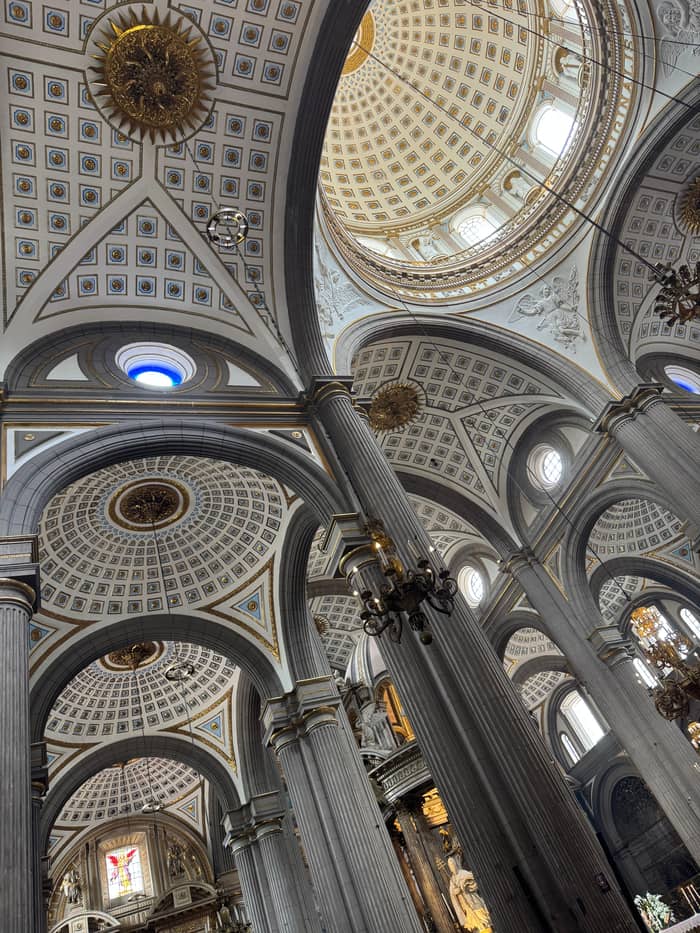
Considered the highest expression of indigenous baroque, the church was declared a historic monument in 1933.
Before you go
The other half of the day is a village church, and it deserves time. The Secretaria de Cultura calls Santa Maria Tonantzintla the highest expression of indigenous baroque, a historic monument since 1933 and the third most visited site in Puebla.5 The church has a Latin cross plan and a hexagonal head.42 The plan is conventional; the interior is not, and the contrast between a plain outline and an overflowing inside is exactly what visitors remember.
Inside, indigenous plasterers filled the walls with dark-skinned angels, children with feather headdresses, tropical fruit such as mango, chile, coconut and banana, and above all vigorous corn cobs.31 INAH explains that stucco baroque flourished in New Spain in the 17th and 18th centuries,43 and that at Tonantzintla the interiors and domes are covered in saints, angels and cherubs in blue, red, pink and gold tones.44 Although inspired by European models, the hand of indigenous artisans gave each angel, flower and symbol a language of its own.45
The Secretaria de Cultura offers a pagan reading and a Christian one. The pagan reading sees the earthly paradise of Tlaloc, god of rain.46 The Christian reading finds the main Marian passages: the Annunciation, the Conception, the Assumption and the Coronation of the Virgin.32 It is believed that a teocalli to the goddess Tonantzin stood here before the Spanish came, and that after the conquest the Spanish built a temple to the Virgin Mary on the same spot.47 If you were hoping for a Cholula legends tour, this layered story is the one the official sources tell, and a local guide can add the versions told in the village.
This site's own day tour from Mexico City has specific timings: a coach of 1 hour, then a viewpoint pause of 20 minutes, another coach of 1 hour, then Cholula for 1.5 hours and the church of Santa Maria Tonantzintla for 40 minutes, before 2.33 hours in Puebla with lunch. The whole day lasts 11 hours and starts from $55. The pyramid block is 90 minutes, a brisk block that leaves little room to linger.
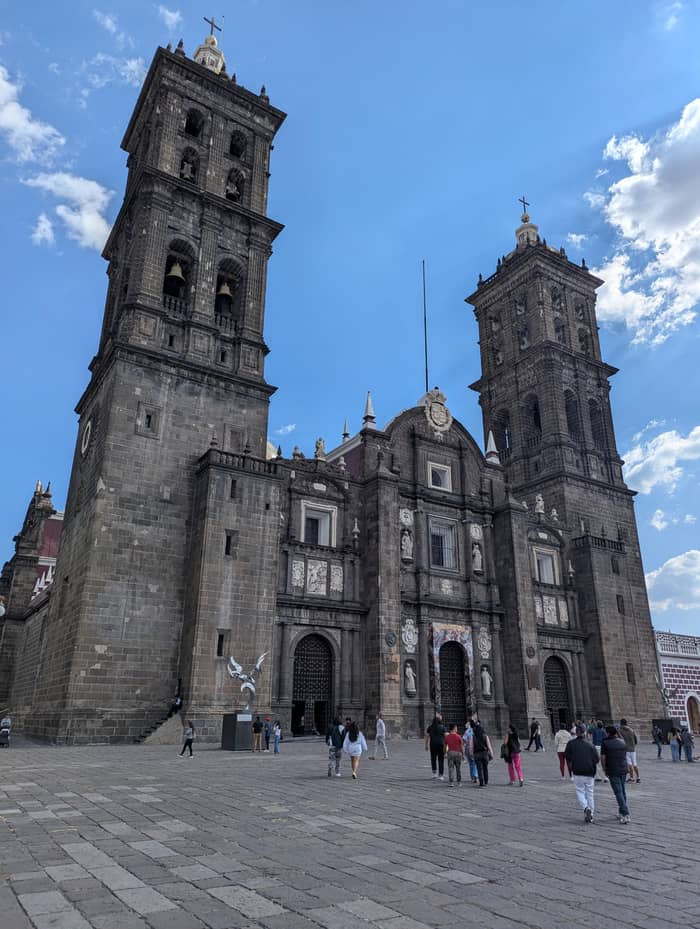
A shorter option starts in Puebla itself: a tour of 4 hours that goes by van to Cholula, stops at San Francisco Acatepec for 25 minutes and at Santa Maria Tonantzintla Church for 25 minutes, from $84. It suits travellers who already sleep in Puebla and want the pyramid and church without a long coach ride. It is also a version that leaves most of the day free in Puebla itself, which matters if you want a long lunch in the city before or after the tour. Compare the stops before you compare the figure.
For more time at the pyramid, look at the other listings. A small group of at most 15 participants from Mexico City takes 10 hours and visits the Great Pyramid with its site and museum, Santa Maria Tonantzintla, San Francisco Acatepec and Puebla, from $192. An 11-hour variant with an optional traditional lunch spends 110 minutes at Cholula and 40 minutes at Tonantzintla, from $82. Pick by the time at the pyramid as much as by the price.
FAQ
INAH places the pre-Hispanic city 7 km from today's city of Puebla.22
Formal work began in 1931 under Ignacio Marquina, whose method of tunnels detected substructures inside the hill.33
Sources
Planning Puebla and Cholula in a day? Ask a real person here.